
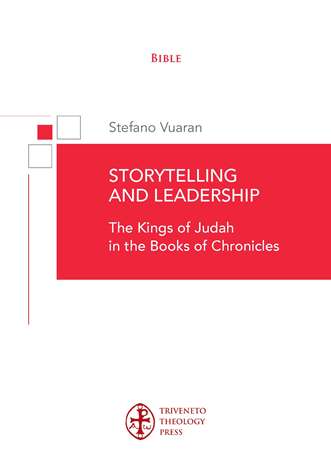
Stefano Vuaran, Storytelling and leadership. The Kings of Judah in the Books of Chronicles (Bible, 1), Triveneto Theology Press, Padova 2026, pp. 456, isbn 979-12-81328-17-4 (pdf) – isbn 979-12-81328-39-6 (paper), open access.
The book of Chronicles, describing the events of the kingdom of Judah, expresses value judgments on individual rulers. Three types can be identified in the text: explicit and direct judgments, through recurring formular expressions; the explicit but indirect judgments, formulated by the voice of the characters who interact with the sovereign in the literary work and who express the position of the author; implicit judgments, through cultural patterns. By applying the perspective of the human sciences, in particular of social psychology, specifically the social identity theory, to these judgments, it’s possible to reach conclusions regarding the message that the Chronicler intends to address to the leadership of the Persian province of Yehud. This is invited to promote the identity of the Israelite people starting from the relationship with Yhwh, specifically in the care of the temple in Jerusalem, the fundamental element of identity. In presenting his agenda, the Chronicler places himself on the line of the prophets, defending the relationship between Yhwh and the people, interpreting the divine word of the past and updating it, so that Israel can find the way to prosperity and peace.
Keywords: Social identity, leadership, temple
Il libro delle Cronache, mentre descrive gli eventi del regno di Giuda, esprime giudizi di valore sui singoli monarchi. Nel testo si possono individuare tre tipologie: giudizi espliciti e diretti, attraverso espressioni formulari ricorrenti; giudizi espliciti ma indiretti, formulati tramite i personaggi che interagiscono con il sovrano nell’opera letteraria e che esprimono la posizione dell’autore; giudizi impliciti, attraverso motivi di carattere culturale. Applicando a questi giudizi la prospettiva delle scienze umane, in particolare della psicologia sociale, nello specifico la teoria dell’identità sociale, è possibile giungere a conclusioni in merito al messaggio che il Cronista intende rivolgere alla leadership della provincia persiana di Yehud. I leader sono invitati a promuovere l’identità del popolo ebraico a partire dal rapporto con Yhwh, in particolare nella cura del tempio di Gerusalemme, elemento fondamentale di tale identità. Nel presentare la sua agenda, il Cronista si pone sulla linea dei profeti, difendendo il rapporto tra Yhwh e il popolo, interpretando la parola divina del passato e attualizzandola, perché Israele possa trovare la via della prosperità e della pace.
Parole chiave: Identità sociale, leadership, tempio
Clicca e scarica gratuitamente il libro.
Leggi l’articolo di presentazione.
L’autore. Stefano Vuaran, presbitero della Diocesi di Concordia-Pordenone, ha conseguito il dottorato in Scienze bibliche e archeologia allo Studium Biblicum Franciscanum di Gerusalemme, dove è visiting professor in Antico Testamento. È docente di Esegesi biblica allo Studio teologico “Card. Celso Costantini” di Concordia-Pordenone, di cui è anche direttore.
Table of contents
Biblical Abbreviations
Introduction
Chapter 1
THE SOCIAL APPROACH TO THE BIBLICAL TEXTS
I. The theory of social (or collective) identity
II. Social identity theory and biblical studies
Chapter 2
THE BOOK OF THE CHRONICLES
I. The text of Chronicles
II. The author of Chronicles
III. The leadership of the kings of Judah in the book of Chronicles
Chapter 3
THE CHRONICLER’S EXPLICIT AND DIRECT JUDGEMENTS ON THE KINGS OF JUDAH
I. Stereotypical formula borrowed from the Deuteronomist: the main explicit and direct judgement
II. Explicit and direct judgements personal to the Chronicler
III. Conclusions on the explicit and direct judgements
Chapter 4
EXPLICIT BUT INDIRECT JUDGEMENTS THROUGH THE SPEECHES OF CHARACTERS IN THE LITERARY WORK
I. Supernatural beings
II. Charismatic figures
III. Priests and levites
IV. The people
V. Sovereigns of the northern kingdom
VI. Foreign sovereigns
VII. Conclusions on the explicit but indirect judgements
Chapter 5
IMPLICIT JUDGEMENTS THROUGH CULTURAL MOTIFS
I. The burials of the kings of Judah
II. Absence or loss of descendants
III. Political and religious geography: the “blurred border” between Judah and Israel
IV. Conclusions on the implicit judgements
GENERAL CONCLUSIONS
I. A prototype with two faces: David and Solomon
II. The norm of basic behavior: the correct relationship with Yhwh
III. The leader as promotor of the Israelite identity
IV. The leadership of Yehud, addressees of the judgements on the kings of Judah
Bibliography
Biblical References
Authors Index
Author Profile
Data di pubblicazione 1 settembre 2026